
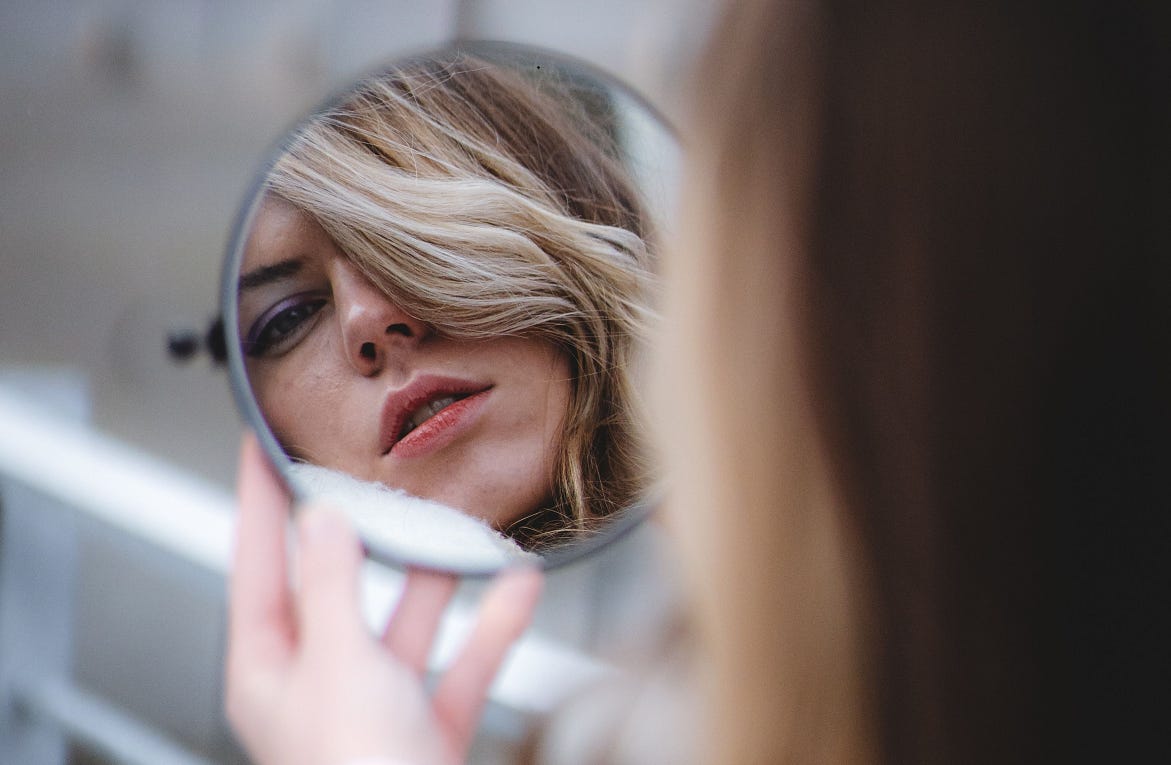
A peculiar question came up in therapy recently:
When one of us looks into a mirror, who does she see?
We’re a DID System of about 60 head mates, ranging in age from four to somewhere in our 40s. Our System turns 63 in a couple of weeks. We’re also post-op trans-female, which adds another interesting wrinkle to the question.
Some of our littles are what we call “time-locked.” A four-year-old head mate understands herself as four. She doesn’t understand why her mommy and daddy have disappeared (our older head mates know they passed away over 10 years ago). She acts age appropriate, and sees herself as four. Telling her that the body is nearly 63 doesn’t somehow make her 63. Her memories of what “we” look like also come from a body that existed decades before transition, including top and bottom surgery.
During a therapy session, one of our littles was working through knowing that she is a girl and some painful memories surrounding our parents’ response to that declaration. At one point, looking in the mirror entered the discussion.
And that left us with what initially sounded like a rather philosophical question. What does she actually see?
We then realized that this question might be physiological as well as psychological.
The obvious answer suddenly wasn’t so obvious
Our first instinct was essentially the conventional one: the mirror reflects the same light regardless of who’s fronting. Same body, same mirror, same eyes, same image. Except... there’s a rather large assumption buried in “same eyes.”
Our System already has some startling physiological differences between head mates. A few of us smoke heavily, up to two packs a day. Most of us are sickened by cigarette smoke. Stranger still, the smokers clearly experience nicotine addiction while the non-smokers experience no noticeable withdrawal when they’re fronting. Our DID therapist tells us that state-dependent physiological differences aren’t an unfamiliar phenomenon in DID.
So we started wondering: is vision physiologically different too? It turns out this question has already been raised.
Same eyes. Different measurements.
In 1996, optometrists Morton Birnbaum and Kathleen Thomann published Visual function in multiple personality disorder. “Multiple personality disorder,” of course, was the terminology then used for what we now call dissociative identity disorder.
Their paper reviewed reports of physiological and ocular differences between identity states and presented a patient they had followed for three years.
The list of reported visual differences is remarkable:
visual acuity
refraction
oculomotor status
visual fields
color vision
corneal curvature
pupil size
intraocular pressure
Those aren’t descriptions of somebody feeling that she looks different. They’re reported differences in measurable properties of the visual system. That changes the mirror question considerably.
The external scene hasn’t changed. Light still leaves the face, reflects from the mirror, and arrives at the eyes. But “the same optical scene reaching the same body” doesn’t establish that the visual system produces an identical physiological response to it.
Refraction affects how light is focused. Pupil size changes the optical system through which that light passes. Oculomotor differences can affect where and how the eyes fixate. Differences in color vision and visual fields concern the information ultimately available to perception.
So the chain actually looks something like this:
face → mirror → optics of the eye → retina → visual pathways → visual cortex → higher visual processing → self-recognition
And DID potentially enters that chain considerably earlier than we expected.
Then things get downright strange
A 2015 paper by Hans Strasburger and Bruno Waldvogel describes an extraordinary case involving a person with DID who had been diagnosed with cortical blindness for 15 years. During psychotherapy, some identity states gradually regained sight. Others remained blind. This presented researchers with a rare opportunity. They could measure visual evoked potentials, or VEPs: electrical responses generated by the nervous system following visual stimulation. In the identity states that could see, VEPs were normal and stable. In the identity states that were blind, the VEPs were absent. Switching between those states could occur within seconds.
Think about what that means for a moment. This wasn’t simply one head mate saying, “I don’t think I can see.” An electrophysiological measurement changed along with the identity state.
The authors proposed top-down modulation of the primary visual pathway, possibly involving the thalamus, and concluded that visual information appeared to be suppressed at an early neural stage. Their precise mechanism remains a hypothesis, but the measured phenomenon itself is fascinating.
Obviously, blindness is an extreme case. It doesn’t establish that my four-year-old and I literally see different faces when looking into the same mirror.
It does establish something much more useful for asking the question:
We cannot safely assume that visual processing remains physiologically identical when identity states change.
DID already has measurable psychobiology
Vision isn’t standing alone here.
A 2006 study led by A.A.T. Simone Reinders examined 11 people with DID while different identity states were exposed to neutral and trauma-related autobiographical memory scripts. Researchers measured subjective responses, cardiovascular responses including heart rate and blood pressure, and regional cerebral blood flow using PET. Different dissociative identity states showed different cardiovascular reactions and different patterns of cerebral activation. Other neuroimaging work has also reported differences in regional cerebral blood flow associated with DID.
None of this means every physiological difference that a plural System notices has been scientifically demonstrated to result from switching. DID research has historically involved small samples, difficult experimental designs, and phenomena that aren’t especially easy to drag into a laboratory. It does mean that “it’s all the same body” is an inadequate scientific answer to every question about state-dependent physiology. The same body can occupy measurably different physiological states.
So what happens in the mirror?
This is where we reach the boundary between what science has demonstrated and the answers we are seeking. We haven’t found an experiment in which researchers asked multiple head mates to look at their shared face in a mirror and then determined whether the resulting visual percept changed with whoever was fronting. That would be a fascinating experiment. There are also several different things we could mean by “seeing someone different,” and they’re easy to collapse into one another. A head mate might see the body’s face perfectly accurately while experiencing: ”That’s me.”
Another might experience: ”I know that’s our body, but that person doesn’t look like me.”
Still another might recognize the face intellectually while experiencing the person in the mirror as a stranger. Someone whose internal self-image differs strongly from the body might experience an immediate mismatch between the expected face and the reflected one. Perhaps some people experience something stranger still: the reflected face itself seems perceptually different depending upon who is looking.
Those experiences could arise at very different points in the perceptual chain. Some differences might concern self-recognition. Others might involve body representation and internal imagery. Still others could involve attention and higher-order visual processing. Given the published findings involving ocular measurements and visual electrophysiology, we don’t think we can automatically exclude state-dependent visual physiology from the possibilities.
That last possibility needs to remain a question. The research we’ve found doesn’t demonstrate that DID head mates literally perceive different facial geometry in a mirror. Neither does the available science justify assuming that every head mate receives an identical visual representation and differs only in how they psychologically interpret it. That’s what makes the question so interesting.
So we asked other Systems
We deliberately stripped most of this science out when we took the question to Reddit. There was a practical reason. We didn’t want to hand people a theory and then ask whether they experienced it. That’s a wonderful way to contaminate an interesting question.
Instead, we simply explained how the question arose and asked other Systems: Who do you see when you look in the mirror? Do you see the body’s face as it physically appears? Do you see yourself as you understand yourself internally? Does the reflection somehow look different depending upon who is fronting? Do you recognize the person in the mirror while simultaneously feeling that they don’t look like you?
The responses have only begun coming in, and we’re deliberately going to let those conversations percolate before writing about what other people report. For now, we’re left fascinated by the question itself.
A mirror seems like one of the simplest measuring instruments humanity ever invented. Put a person in front of it and light gives you an image of the person standing there. For a DID System, however, there is another instrument sitting between that mirror and conscious experience.
The brain.
And apparently, changing who is looking can change considerably more than we once thought.
Our responses on Reddit are already falling into several fascinating categories: recognition without ownership, altered feature salience, and reported visual overlays.
We’ll explore what people are telling us next time.
Sources / Further Reading
